


















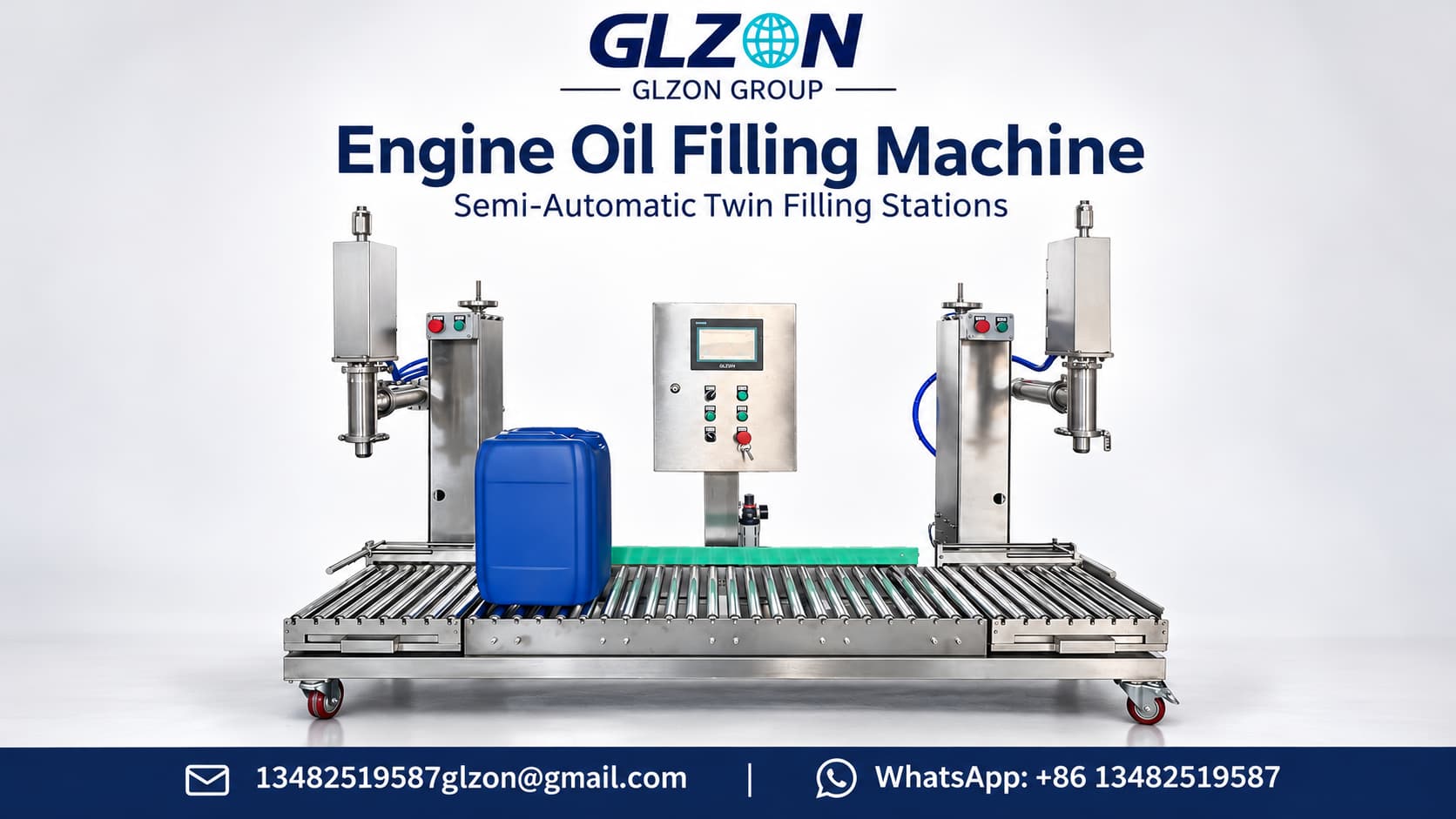
Un Engine Oil Filling Machine can handle both 5 L and 20 L jerrycans if the filling head reaches both openings, the line holds each container steady and the closing station accepts both caps. Before ordering, ask the supplier to run your 5 L pack, change the line over, then produce an accepted 20 L pack. Record the fill quantity, cap condition and elapsed time. That single trial answers a purchasing question a capacity range alone leaves open: can your team run both packs within the same production schedule?
In this buyer’s guide
- Compare the two jerrycan formats
- Choose how to measure the fill
- Check the cap and closure
- Calculate the output for each pack size
- Run a timed changeover trial
- Compare supplier quotations
- Common buying questions
- Request a quotation
Can One Engine Oil Filling Machine Handle Both 5 L and 20 L Jerrycans?
Start with the position of the neck. Two jerrycans can have the same opening diameter but place that opening at different distances from the side guide. When the larger container enters the machine, changing nozzle height alone may leave the tip above the shoulder or handle. Send the supplier a top-view drawing of each pack and mark which face runs against the conveyor guide.
| Buyer requirement | Configuration to discuss | What to verify with samples |
|---|---|---|
| Reach both neck openings | Adjustable guides, nozzle position or format-specific locating parts | Run each jerrycan in its normal orientation. Check clearance around the neck and handle as the nozzle enters and withdraws. |
| Keep the empty 5 L pack steady | Guides and a stop that locate the pack under the nozzle | Watch consecutive empty jerrycans enter the station. Check whether the shoulder flexes, the pack turns or the operator has to reposition it. |
| Move the full 20 L pack | A conveyor and transfer points sized for the filled container | Run a full pack across the joint between filler and capper. Check for tipping, hesitation or contact with the guides. |
| Switch sizes during a shift | Marked settings and a list of parts exchanged during changeover | Have one operator repeat the change using the proposed instructions. Record the tools, time and first accepted pack. |
For the supplier drawing, include the outside dimensions, neck inside diameter, neck height, cap outside diameter and distance from the neck center to two adjacent sides. A top photograph with the cap removed is especially helpful when the handle sits close to the opening.
Should an Engine Oil Filling Machine Measure by Weight or Volume?
Start with the quantity printed on your pack and the method your quality team uses to release a batch. For a product sold by volume, give the supplier the nominal volume, permitted deviation and verification procedure. You can then compare proposals that dispense a measured volume with proposals that use a scale to deliver a corresponding mass.
For a net-weight system, agree on how the machine records the empty jerrycan weight and establishes the target for each oil grade. If your team converts between liters and kilograms, document the product density and its reference temperature. Keep those details with the filling settings so operators can select the right combination of grade and pack size.
Worked example. Suppose a particular engine oil has a documented density of 0.86 kg/L at the agreed reference temperature. A 5 L fill corresponds to 4.30 kg of oil, and a 20 L fill corresponds to 17.20 kg. Both figures exclude the container. Use the density supplied for your own product when preparing a production target.
Ask for trial results at both sizes. A supplier can show a good 20 L fill while leaving an important question unanswered: how consistently does the same nozzle stop at the smaller target? Record several consecutive fills and inspect the neck immediately after shutoff. A pack can meet its quantity target and still carry oil onto the cap or label area.
How Do You Check Whether Both Jerrycan Caps Will Run?
Send matched sets of containers and caps, including any liner, tamper band or spout supplied with the production pack. Similar-looking caps can require different handling. The trial should cover how the cap arrives, how it sits on the neck, how the closing head engages it and how the operator verifies the finished closure.
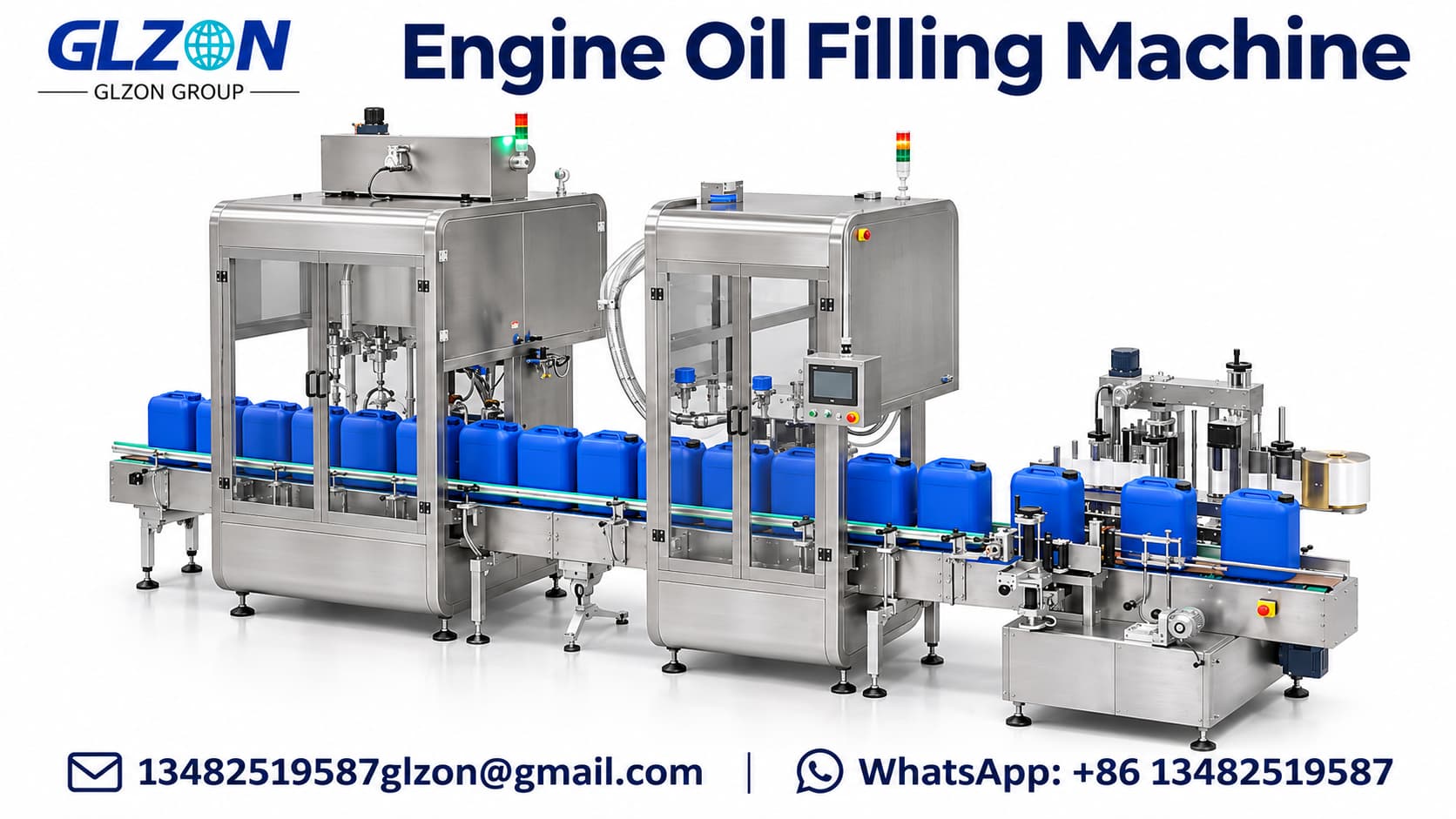
GLZON’s overview of automatic engine oil filling for jerrycans describes capping as an option. When comparing offers, ask the supplier to identify which of the following operations the quoted line includes.
- Cap placement. Does an operator place each cap, or does a feeder orient and deliver it? Ask what changes when switching cap sizes.
- Cap tightening. For a threaded closure, provide the cap supplier’s tightening specification and agree on how the finished closure will be checked.
- Container support. Watch whether the jerrycan rotates or its sidewall deforms while the head tightens the cap.
- Finished-pack inspection. Check cap seating, tamper-band condition where applicable, and leakage using your agreed package test.
If the caps are identical on both sizes, bring both containers anyway. The taller 20 L pack changes the working height, while a narrower 5 L pack may contact the side guides at a different point. Those adjustments still count toward changeover time.
What Output Should You Request for Each Jerrycan Size?
Specify finished, capped jerrycans per hour for each format. A line quoting only liters per minute leaves out container positioning, nozzle movement, transfer and capping. A line quoting only packs per hour leaves out the amount of oil the feed system must supply.
Example production plan. Consider a plant with separate orders for 600 five-liter jerrycans and 180 twenty-liter jerrycans. Each order has three hours of actual running time. The larger pack requires fewer caps per hour, yet it requires more oil per hour.
| Example order | Finished output required | Average oil delivery over the run | Average time between completed packs |
|---|---|---|---|
| 600 × 5 L in 3 hours | 200 jerrycans/hour | 1,000 L/hour | 18 seconds |
| 180 × 20 L in 3 hours | 60 jerrycans/hour | 1,200 L/hour | 60 seconds |
Use the 5 L run to assess cap supply and pack handling at the higher container rate. Use the 20 L run to assess oil supply and full-container transfer. The oil figures above are averages across the run. If a nozzle dispenses for only part of each cycle, it must deliver oil faster during the time it is open. Give the supplier your oil viscosity, filling temperature and existing pump details before agreeing on a cycle time.
How Do You Run a Meaningful 5 L to 20 L Changeover Trial?
Start the clock when the last accepted 5 L jerrycan leaves the station. Stop it when the first 20 L jerrycan meets both the fill and closure criteria. This captures the adjustments and first-pack checks your operators will perform on the production floor.
- Agree on acceptance criteria. Identify the oil grade, temperature, fill target, permitted deviation, closure check and required output for each size.
- Run the 5 L pack. Use production jerrycans and caps. Record consecutive results, inspect the necks and count finished packs at discharge.
- Change the format. Have the operator adjust the guides, filling height, nozzle position and capper. Record each part exchanged and each setting entered manually.
- Approve the first 20 L pack. Verify the quantity, cap seating and discharge transfer. Record any trial packs used before approval.
- Continue the 20 L run. Watch what happens when the next full jerrycan reaches the closing station. Include any waiting time in the output record.
- Return to 5 L. Check whether the operator can recover the previous settings and produce an acceptable pack. A marked guide position is useful only if the result is repeatable.
If possible, change container size while keeping the oil grade constant for this first test. Run a separate grade-change trial if your plant also needs to drain or flush the feed path. Keeping separate time records helps production planners schedule a packaging change and a product change accurately.
What Should an Engine Oil Filling Machine Quotation Include?
Ask each supplier to quote against the same pair of jerrycans and the same production targets. A useful offer identifies what arrives with the machine, what your plant supplies and which items carry an optional price.
| Quotation item | Detail to request in writing |
|---|---|
| Filling station | Measurement method, nozzle count, supported container drawings and fill acceptance criteria for each size. |
| Oil supply | Inlet requirements, feed pump responsibility, hose connections and assumed product temperature. |
| Cap handling | Manual or automatic placement, tightening head, included cap formats and inspection method. |
| Change parts | Guides, holders, cap tooling and other parts included for each pack. Request individual prices for additional formats. |
| Line integration | Conveyor sections, transfer heights, utility connections and responsibility for interfacing with an existing labeler. |
| Handover | Trial record, approved settings, changeover instructions, operator training and spare-part references. |
Domande frequenti
Are two filling nozzles necessary for a 5 L and 20 L line?
Nozzle count depends on the production target and available oil supply. Ask the supplier to demonstrate the required finished output with the proposed number of heads. If both nozzles share a feed pump, run them together during the trial and check the quantity delivered through each head.
Can we test with water before sending engine oil?
A water trial can help show container movement and nozzle alignment. Use representative engine oil for the final checks on dispensing time, shutoff, dripping and changeover between grades. Record the oil temperature so your plant can compare the trial with its normal operating conditions.
What if two packaging suppliers make our 5 L jerrycans?
Provide samples from both suppliers under separate pack references. Compare neck position, handle clearance, body width and cap fit. If the same settings work for both, record that in the trial report. If operators need an adjustment, add it to the changeover sheet.
Can we add labeling after the filling line is installed?
Yes, if the proposed discharge arrangement suits the future labeler. Reserve floor space and agree on conveyor height, travel direction and container spacing. During the filling trial, inspect the label panel for oil after the pack leaves the capper.
Request an Engine Oil Filling Machine Quotation
For a GLZON quotation, send the details below for each jerrycan. If your plant already owns a pump, conveyor or capper, identify it so the supplier can show the connection point on the proposed layout.
- Engine oil grades, viscosity at filling temperature, and density if you convert between weight and volume.
- Target fill quantity, permitted deviation and required finished jerrycans per hour for both 5 L and 20 L packs.
- Container dimensions, neck opening diameter, and top and side photos of each jerrycan.
- Matching cap samples, closure specifications and any liner or tamper-band requirements.
- Typical batch sizes, number of format changes per shift and available operating time.
- Available floor space, conveyor direction and the filling, capping or labeling operations you want included.