















Automatic Bottle Labeling Machine for Round and Square Bottles
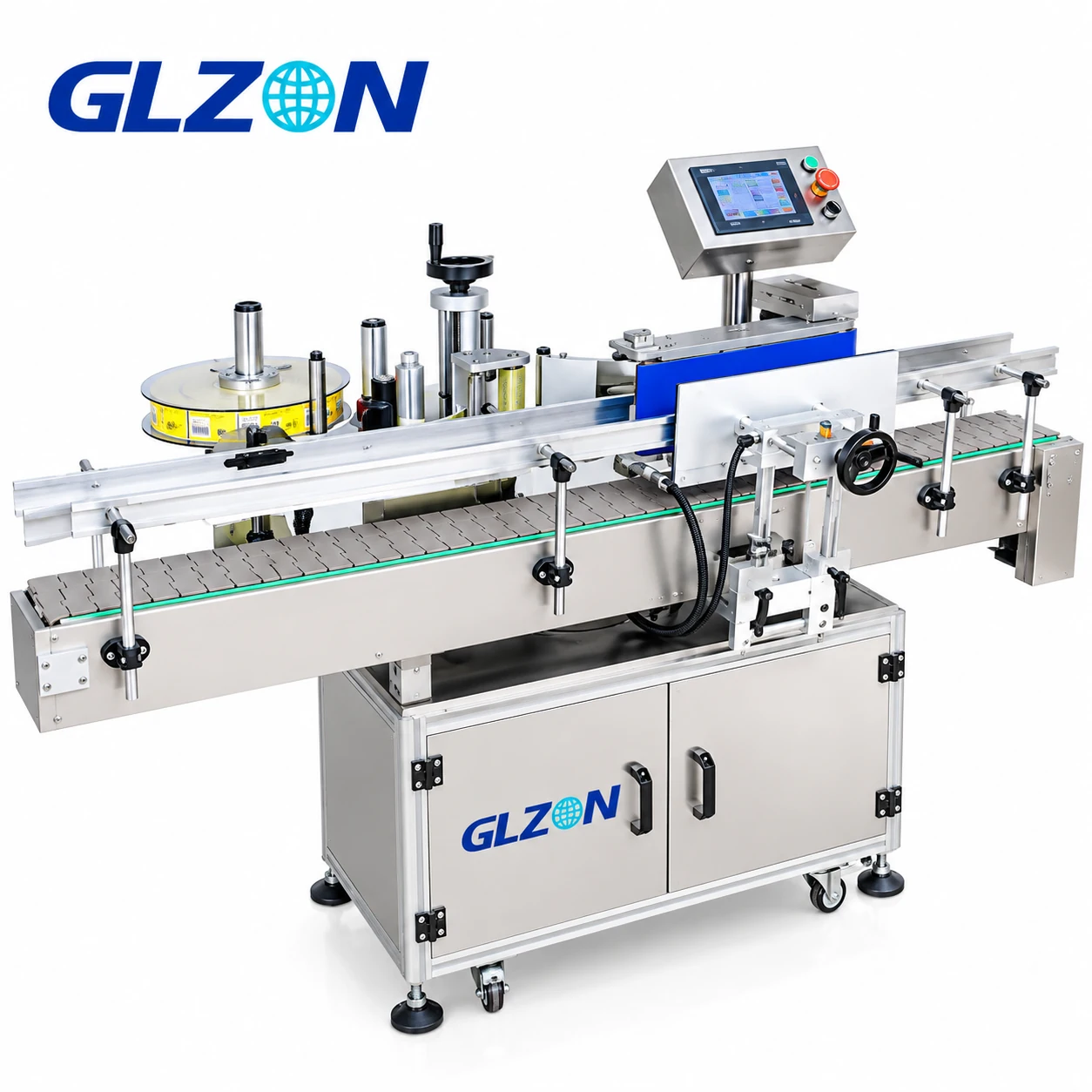
The automatic bottle labeling machine helps manufacturers apply labels to round and square bottles with consistent positioning. It uses photoelectric detection technology to coordinate label placement and reduce wrinkles during the labeling process.
This equipment supports single-sided and double-sided labeling arrangements for suitable containers. In addition, its conveyor-based design can connect with compatible filling and packaging lines.
GLZON provides industrial filling and packaging equipment for different manufacturing applications. Therefore, customers can discuss suitable labeling solutions according to their bottle dimensions, label specifications, and production requirements.
Automatic Bottle Labeling Machine Overview
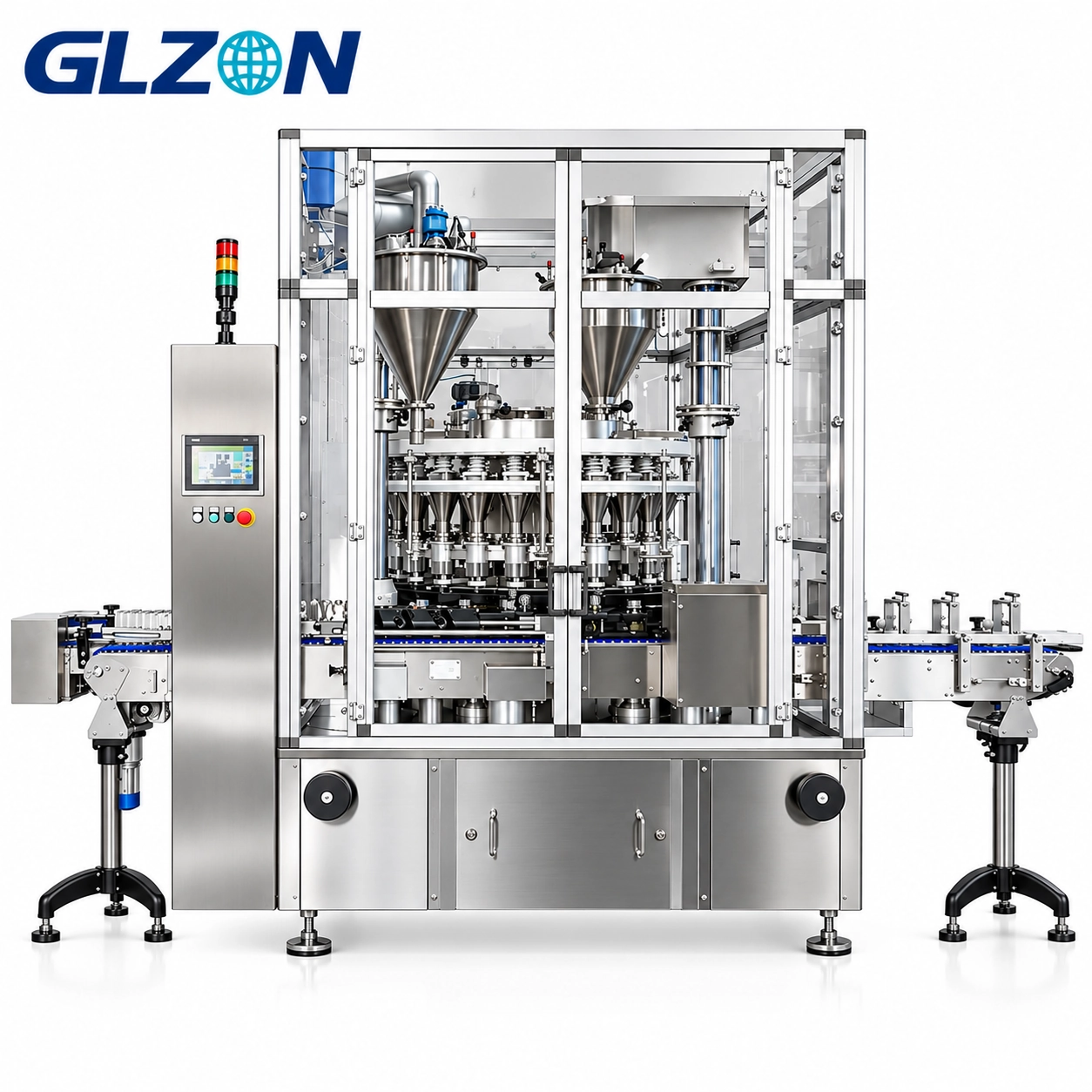
An automatic bottle labeling machine simplifies the process of applying product labels to containers.
First, a conveyor transfers bottles toward the labeling station. Next, the positioning system detects the containers and coordinates label application. The machine then applies the labels according to its configuration.
As a result, manufacturers can improve packaging consistency while reducing repetitive manual labeling tasks.
The reference equipment supports different round and square container specifications. Moreover, its design aims to reduce wrinkles and maintain smooth label placement.
Key Features of the Bottle Labeling Machine
1. Automatic Label Application
The machine coordinates bottle movement and label application through its labeling mechanism.
This arrangement reduces manual label placement during normal production. Consequently, manufacturers can organize their packaging process more efficiently.
However, the exact automation functions depend on the selected model.
2. Photoelectric Label Positioning
The equipment uses photoelectric detection to support label positioning.
This system helps coordinate the movement of bottles with label application. In addition, it can improve consistency across repeated labeling cycles.
However, the source does not provide a numerical positioning accuracy.
3. Round Bottle Labeling
The machine supports labeling applications involving compatible round containers.
For example, suitable cylindrical bottles may require labels on a selected part of their surface.
The correct labeling arrangement depends on bottle diameter, label dimensions, and surface characteristics.
Therefore, buyers should confirm compatibility before selecting equipment.
4. Square Bottle Labeling
The reference also describes support for square containers.
This capability may suit packaging designs that require labels on flat container surfaces.
However, square bottles can have different dimensions and corner designs.
As a result, manufacturers should provide bottle samples or technical drawings for evaluation.
5. Single-Sided Labeling
The machine supports single-sided labeling according to the reference description.
This option suits products that require a label on one selected container surface.
In addition, the labeling arrangement can support different packaging designs.
6. Double-Sided Labeling
The equipment also supports double-sided labeling.
For example, some bottles require separate front and back labels.
This configuration can help manufacturers apply labels to two required surfaces.
However, the exact application sequence and supported bottle shapes require confirmation.
7. Smooth Label Application
The reference manufacturer describes the equipment as capable of applying labels smoothly while reducing wrinkles.
Consistent label placement improves the presentation of packaged products.
Moreover, suitable positioning and application control can reduce unnecessary label adjustments.
Actual results depend on bottle surfaces, label materials, and machine settings.
8. Conveyor Integration
The machine includes a conveyor arrangement for transporting containers through the labeling station.
This feature supports continuous bottle handling within the packaging process.
In addition, manufacturers can evaluate integration with suitable upstream filling and capping equipment.
Technical Specifications
| Technical Parameter | Reference Configuration |
|---|---|
| Machine type | Bottle labeling machine |
| Bottle shape | Round and square containers |
| Labeling arrangement | Single-sided and double-sided |
| Positioning system | Photoelectric detection |
| Container transportation | Conveyor |
| Operation | Machine-assisted label application |
| Production-line integration | Supported |
| Labeling speed | Not specified |
| Labeling accuracy | Not specified |
| Bottle dimensions | Not specified |
| Label dimensions | Not specified |
| Power requirements | Not specified |
GLZON’s final machine specifications and supported bottle designs require confirmation.
Applications of the Automatic Bottle Labeling Machine
Chemical Bottle Labeling
Chemical manufacturers use labels to identify their packaged products.
An automatic labeling system can support consistent application on suitable chemical bottles.
However, manufacturers must prepare appropriate label content and confirm container compatibility.
Cleaning Product Bottle Labeling
Manufacturers of cleaning liquids use various bottle shapes and packaging designs.
A suitable labeling machine can help apply product labels consistently. In addition, conveyor integration can support a coordinated packaging workflow.
Coating and Industrial Liquid Packaging
Some industrial liquids use smaller bottles for storage or distribution.
A bottle labeling machine can support product identification and packaging presentation.
However, the selected configuration must match the bottle dimensions and required label placement.
Other Compatible Bottle Packaging
The machine may also suit other products that use compatible round or square bottles.
Nevertheless, buyers should verify bottle materials, label properties, and production requirements before choosing equipment.
How Does an Automatic Bottle Labeling Machine Work?
The labeling process follows a coordinated sequence.
Step 1: Bottle Feeding
First, the conveyor transfers bottles toward the labeling station.
Step 2: Bottle Detection
Next, the photoelectric system detects the bottle position.
Step 3: Label Positioning
The machine coordinates label application with the bottle’s location.
Step 4: Label Application
The labeling mechanism applies the label to the required surface.
Step 5: Additional Labeling
Where the configuration supports it, the system applies a second label.
Step 6: Bottle Output
Finally, the conveyor transfers the labeled bottle toward the next packaging stage.
The actual operating sequence depends on the chosen equipment configuration.
Advantages of Automatic Bottle Labeling Equipment
Consistent Label Placement
Photoelectric positioning helps coordinate label application.
As a result, manufacturers can achieve more consistent packaging presentation.
Reduced Manual Labeling
The equipment reduces the need for repetitive manual label placement.
Therefore, operators can focus on other production activities.
Flexible Labeling Options
The reference supports both single-sided and double-sided applications.
In addition, it accommodates compatible round and square containers.
Smooth Packaging Appearance
The machine aims to reduce wrinkles during label application.
Consequently, manufacturers can improve the consistency of the finished package.
Production-Line Compatibility
Conveyor integration allows the labeling station to connect with suitable packaging equipment.
This can help coordinate filling, capping, and labeling operations.
Single-Sided vs. Double-Sided Bottle Labeling
Manufacturers choose labeling arrangements according to their packaging designs.
Single-sided labeling applies a label to one selected surface.
In contrast, double-sided labeling supports front and back label placement where the machine configuration allows it.
For example, a product may require a front label for branding and a back label for instructions.
Therefore, customers should confirm their label placement requirements before selecting equipment.
How to Choose the Right Bottle Labeling Machine
Choosing suitable labeling equipment starts with understanding the container.
First, identify whether the bottles are round, square, or another shape.
Next, confirm their dimensions and surface materials.
Also, provide the required label length, width, and application position.
In addition, establish the target production speed.
Manufacturers should also confirm whether they need one-sided or two-sided labeling.
Finally, review conveyor compatibility, electrical requirements, and factory installation space.
By sharing these details, customers can help GLZON evaluate a suitable labeling solution.
Why Choose GLZON for Bottle Labeling Equipment?
GLZON focuses on industrial filling machines and supporting packaging equipment.
Different bottle shapes and label arrangements require different machine configurations.
Therefore, equipment selection should consider bottle dimensions, label specifications, and production capacity.
Our team can discuss suitable labeling equipment options for your packaging project.
In addition, customers can ask about integration with compatible filling, capping, and conveyor systems.
Pertanyaan yang Sering Diajukan
What is an automatic bottle labeling machine?
An automatic bottle labeling machine applies product labels to compatible bottles using mechanical labeling equipment and positioning controls.
Can the machine label round bottles?
Yes. The reference supports round containers. However, the exact supported bottle diameter requires confirmation.
Can it label square bottles?
The reference also describes square-container compatibility. The final configuration must match the bottle dimensions.
Does it support double-sided labeling?
Yes. The reference includes single-sided and double-sided labeling options.
What is photoelectric labeling?
Photoelectric detection helps identify bottle positions and coordinate label application.
Can the machine apply front and back labels?
The reference describes double-sided labeling. However, the exact supported bottle shapes and application sequence require confirmation.
What is the labeling speed?
The reference does not provide a labeling speed. Therefore, GLZON must confirm the actual production capacity.
Does the machine print labels?
The supplied reference does not confirm label-printing capability. Buyers should discuss printing requirements separately.
Can it connect with a filling line?
Yes. The reference describes compatibility with suitable filling production lines.
Can GLZON provide a quotation?
Customers can contact GLZON with bottle samples or dimensions, label specifications, and required production speed to discuss equipment and pricing.
Request an Automatic Bottle Labeling Machine Quotation
Are you searching for an automatic bottle labeling machine for your packaging production line?
GLZON can discuss your requirements and help you evaluate suitable labeling equipment.
Please share your bottle shape, dimensions, label size, desired labeling arrangement, and target production capacity.
Contact GLZON today to request machine specifications, equipment pricing, and a customized bottle labeling solution.