


















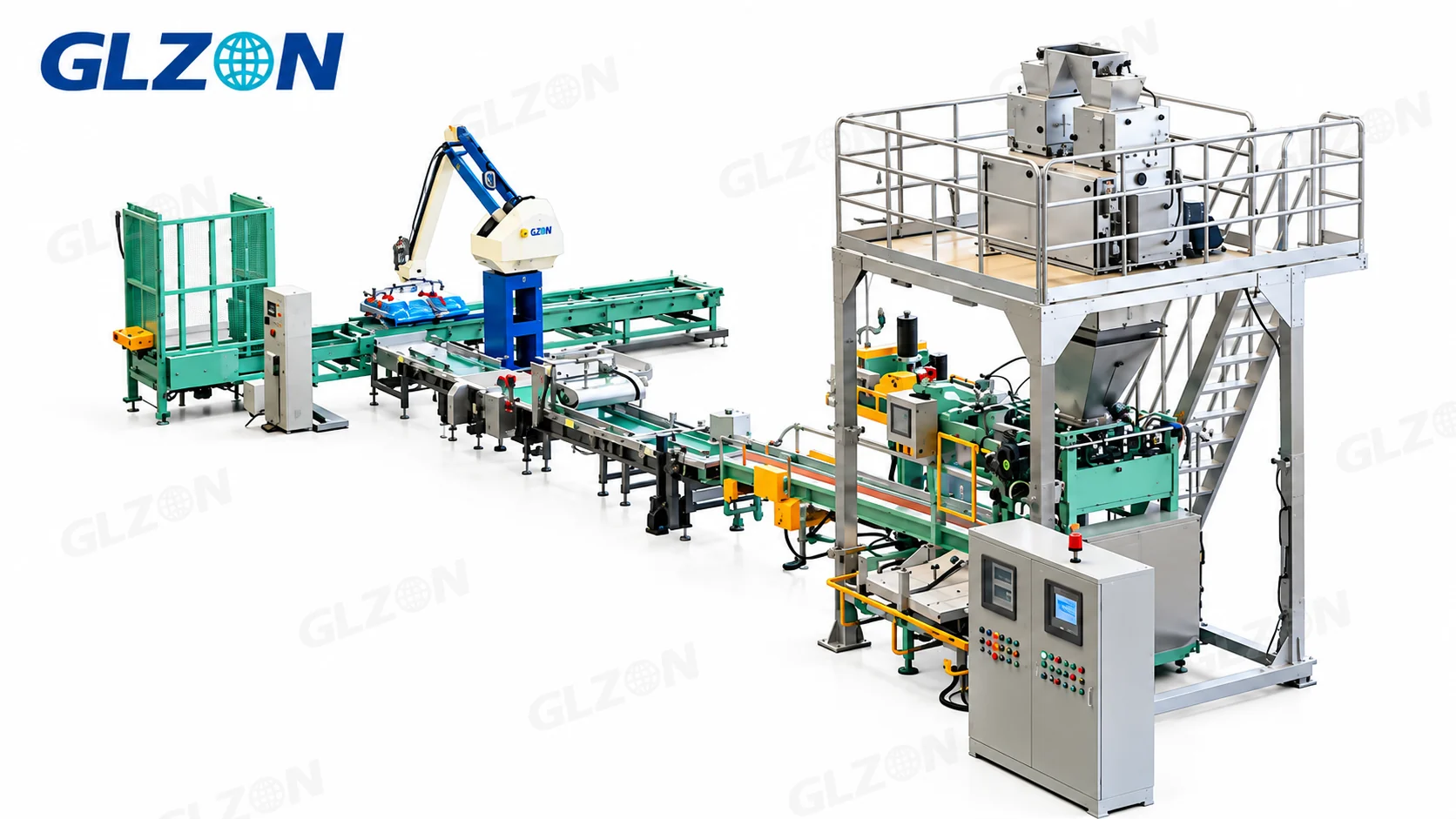
Automatic Bagging and Palletizing Line for Powder and Granule Packaging
An automatic bagging and palletizing line is an integrated industrial packaging solution designed to automate material weighing, bag filling, closing, conveying, and pallet stacking. It helps manufacturers improve packaging consistency, reduce manual handling, and organize their production processes more efficiently.
GLZON Equipment Co., Ltd., based in Shanghai, China, provides industrial filling, bagging, and palletizing equipment for manufacturers looking to improve their packaging operations.
Whether your production facility handles fertilizer, plastic granules, grain, or industrial powders, the appropriate automatic packaging system can be configured according to your material characteristics, bag requirements, and production targets.
What Is an Automatic Bagging and Palletizing Line?
An automatic bagging and palletizing line connects several packaging processes into one coordinated production system.
Instead of manually filling individual bags, transferring them to a sealing station, and stacking them onto pallets, an automated line uses weighing equipment, bag handling mechanisms, conveyors, and palletizing machinery.
A typical system can incorporate:
- Automatic empty bag feeding and positioning
- Precision weighing and material filling
- Automatic bag sewing or sealing
- Belt conveyor and bag transfer systems
- Bag shaping and positioning equipment
- Weight inspection and rejection systems
- Robotic or mechanical palletizing equipment
- PLC control and operator interface
The final equipment configuration depends on the material, packaging format, and automation requirements.
How Does an Automatic Bagging and Palletizing Line Work?
1. Automatic Bag Feeding
The packaging process begins with an automatic bag feeding system. Empty bags are picked from a storage magazine and positioned at the filling station.
Automated bag handling reduces repetitive manual operations and supports a more consistent packaging cycle.
2. Automatic Weighing and Filling
A weighing and filling machine measures the required quantity of powder or granular material and dispenses it into the bag.
Depending on the product’s flow characteristics, the packaging system may use gravity feeding, screw feeding, vibration feeding, or another suitable filling method.
Accurate weighing helps maintain consistent package weights and limit unnecessary product giveaway.
3. Automatic Bag Sewing or Sealing
After filling, the bag moves toward a closing station.
The closing method depends on the packaging material and bag design. Available approaches can include sewing, heat sealing, or a suitable valve bag closing process.
Proper bag closure supports cleaner handling during transportation and storage.
4. Bag Conveying and Inspection
Conveyor systems transport filled bags through the packaging line.
Depending on production requirements, additional equipment may include:
- Checkweighers for verifying filled bag weights
- Metal detection equipment for applicable inspection processes
- Reject conveyors for separating nonconforming packages
- Bag flattening and shaping equipment
- Inkjet printers for batch numbers and product identification
These stations help manufacturers establish an organized packaging and quality control process.
5. Automatic Robotic Palletizing
The final stage involves stacking completed bags onto pallets.
A robotic palletizing system picks up filled bags and arranges them according to a programmed stacking pattern.
The palletizing layout can be designed around bag dimensions, pallet specifications, stacking height, and production capacity.
Automated pallet stacking helps reduce repetitive lifting and prepares finished products for warehousing and shipment.
Key Benefits of Automatic Bagging and Palletizing Equipment
Improved Packaging Efficiency
Connecting weighing, filling, bag closing, and palletizing processes reduces unnecessary material movement between stations.
This allows production teams to create a more coordinated packaging workflow.
Reduced Manual Material Handling
Automatic bag feeding, conveyors, and robotic palletizers can reduce labor-intensive handling tasks.
Operators can focus on equipment monitoring, material supply, quality control, and production management.
Consistent Filling Accuracy
Weight-based filling systems help manufacturers maintain more consistent package quantities.
The achievable filling accuracy depends on the selected machinery, material properties, and operating conditions.
Better Dust Management
For powder packaging applications, suitable dust extraction and enclosed filling arrangements can help control airborne material during filling.
Dust management equipment should be selected according to the specific product and production environment.
Flexible Packaging Solutions
Automatic bagging equipment can be configured for different bag materials and packaging processes, making it suitable for a variety of industrial applications.
Industrial Applications of Automatic Bagging Machines
Fertilizer Industry
An automatic fertilizer bagging machine can be used for weighing and packaging granular or powdered fertilizer products.
A palletizing system can subsequently arrange filled bags for storage and distribution.
Chemical and Mineral Processing
Industrial powder packaging systems are used for suitable mineral powders, pigments, and dry chemical materials.
The correct filling and dust-control equipment must be selected based on the material’s handling characteristics and safety requirements.
Food and Agricultural Products
Automatic bagging systems can be designed for products such as rice, grains, sugar, flour, and animal feed.
Food-contact construction and hygiene requirements should be reviewed during equipment selection.
Plastic Granules and Polymer Materials
Granule bag filling machines are suitable for handling plastic pellets and other free-flowing granular products.
Integrated weighing, bag closing, and palletizing can simplify packaging operations in plastic manufacturing facilities.
Construction Materials
Dry mortar, cement, mineral powders, and other building materials may require bag filling systems selected for their density, abrasiveness, and dust characteristics.
Valve bag fillers and open-mouth bagging machines provide different packaging options for these applications.
Supported Bag Types and Packaging Options
Depending on the selected equipment, industrial packaging lines may accommodate:
- PP woven bags
- PE plastic bags
- Paper bags
- Paper-plastic composite bags
- Open-mouth bags
- Valve bags
Bag compatibility depends on the filling machine, bag dimensions, closing method, and material characteristics.
Manufacturers should confirm their exact bag specifications before selecting a packaging system.
Why Choose GLZON for Industrial Packaging Equipment?
GLZON specializes in industrial filling, weighing, bagging, and automation equipment.
Our product range includes powder and granule bagging machines, valve bag filling equipment, conveyor systems, and palletizing solutions.
We understand that different products require different filling technologies and production layouts.
For this reason, selecting an automatic bagging and palletizing line begins with understanding the customer’s material, target bag weight, production capacity, available factory space, and preferred automation level.
Our goal is to help customers identify practical packaging equipment solutions that meet their production requirements.
How to Choose the Right Automatic Packaging Line
Before requesting an automatic bagging machine quotation, manufacturers should prepare the following information:
- Material: Powder, granules, pellets, or another dry bulk product.
- Bag weight: Required filling weight per bag.
- Production capacity: Target number of bags per hour.
- Bag type: Open-mouth bag, valve bag, woven bag, or another packaging format.
- Closing method: Sewing, heat sealing, or another compatible closure.
- Pallet specifications: Pallet dimensions, stacking height, and preferred bag arrangement.
- Automation requirements: Automatic filling only or a complete bagging and palletizing production line.
Providing these details helps determine the appropriate machinery and production layout.
Frequently Asked Questions
What is an automatic bagging and palletizing line?
It is an industrial packaging system that combines weighing, bag filling, bag closing, conveying, and automated pallet stacking into a coordinated production process.
Can one packaging line handle both powders and granules?
Different feeding mechanisms can accommodate different material properties. A system designed for multiple products must be evaluated for material compatibility, cleaning requirements, and filling performance.
What bag sizes can an automatic bagging machine fill?
The available filling weight depends on the machine model. Manufacturers commonly evaluate industrial packaging equipment for 20 kg, 25 kg, and 50 kg bags, among other packaging weights.
Can robotic palletizing be integrated with an existing bagging machine?
Yes, integration may be possible depending on the existing equipment, conveyor arrangement, bag presentation, control system, and available installation space.
How much does an automatic bagging and palletizing line cost?
The price depends on production capacity, filling technology, automation level, number of stations, robotic palletizing equipment, and customization requirements. A technical quotation is needed to establish the final cost.
Request an Automatic Bagging and Palletizing Line Quotation
Are you looking for an automatic bagging machine manufacturer in China or a customized industrial packaging solution?
الاتصال GLZON Equipment Co., Ltd. to discuss your powder or granule packaging requirements.
Share your material type, bag weight, required filling speed, bag specifications, and factory layout so our team can review the most suitable equipment configuration.
Contact GLZON today to request product information, technical consultation, and a customized quotation.