


















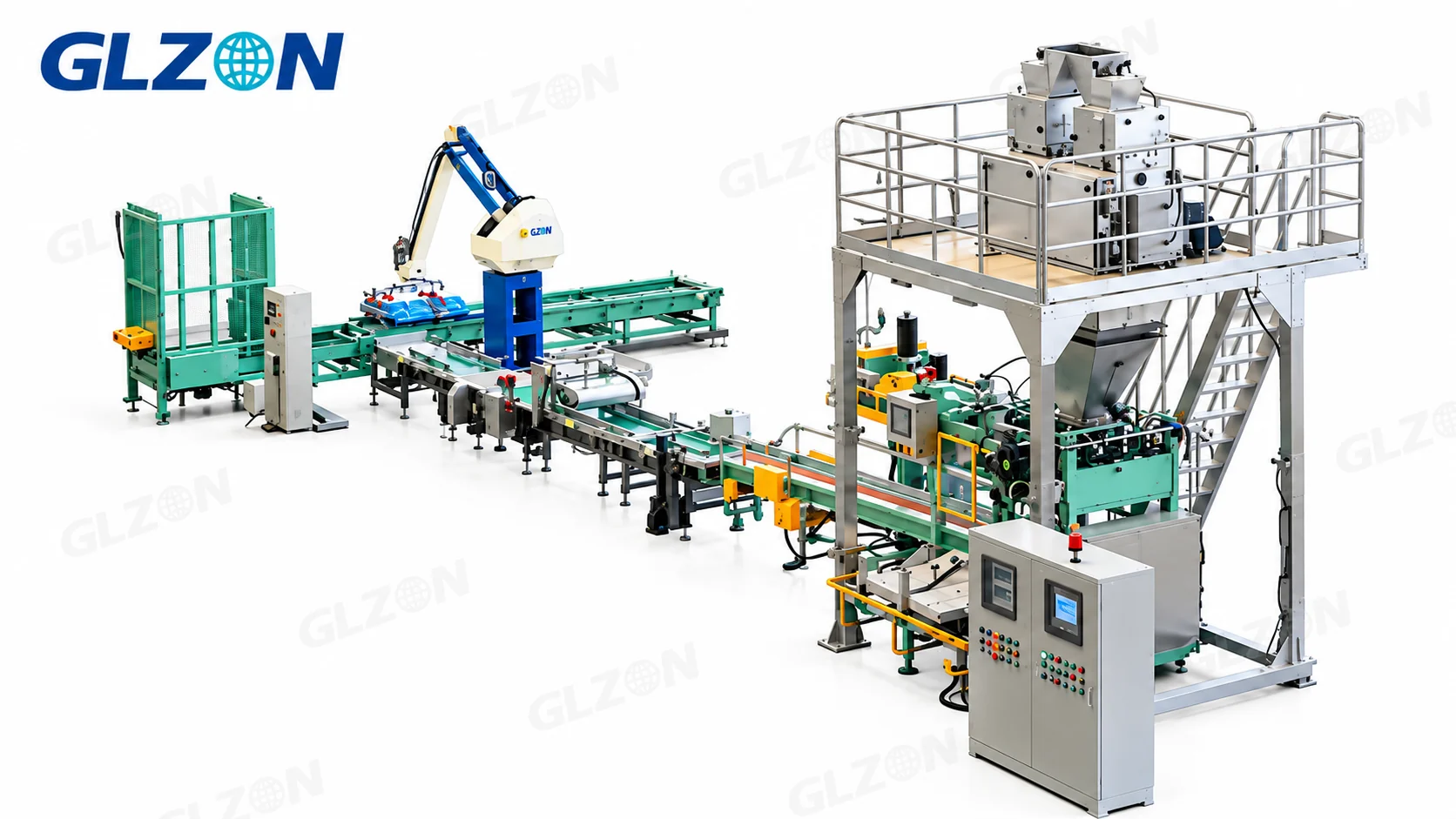
Manufacturers of grain, fertilizer, feed, cement, chemicals, and food ingredients share one end-of-line challenge: getting product into bags and onto pallets quickly, accurately, and safely. Manual handling slows output, raises injury risk, and makes costs unpredictable. A modern สายการผลิตการบรรจุถุงและจัดวางบนพาเลทแบบอัตโนมัติ solves these problems by combining weighing, filling, sealing, conveying, and stacking into one continuous, automated process.
This guide explains how these systems work, what they include, and what to consider before you invest.
What Is an Automatic Bagging and Palletizing Line?
An สายการผลิตการบรรจุถุงและจัดวางบนพาเลทแบบอัตโนมัติ is an integrated packaging system. It takes bulk material from a hopper or silo, weighs it, fills it into bags, seals the bags, checks their weight, and stacks them onto pallets in a programmed pattern. Pallets are then ready for wrapping and shipping.
Because every stage is linked through a central PLC control system, the line runs with minimal operator input. Operators monitor the process and handle changeovers rather than lifting 25 to 50 kg bags all day.
Typical Capacity Range
Output depends on bag size, product flow, and configuration. Most lines run between 300 and 2,400 bags per hour, and high-speed configurations with multiple filling spouts and robotic palletizers can go higher.
Key Components of the Line
1. Bulk Feeding and Weighing System
Material flows from a silo or buffer hopper into a weighing scale. Gross-weigh, net-weigh, and loss-in-weight scales are common. Precision load cells keep fill accuracy within a narrow tolerance, which reduces product giveaway and protects you from underfilled-bag complaints.
2. Bagging Machine
The bagger opens or places the bag, fills it, and holds it in position. Options include:
- Open-mouth baggers for sewn or glued PP woven, paper, and polyethylene bags
- Valve bag fillers for cement, powders, and fine minerals
- Form-fill-seal (FFS) machines for pre-formed film or tubular film bags
3. Bag Closing Station
After filling, bags are closed by sewing, heat sealing, or gluing, depending on the bag material. A bag flattener or shaper then evens out the contents so bags stack neatly.
4. Quality Control Equipment
Checkweighers reject bags that fall outside the target range. Metal detectors and bag-reject systems add food-safety and quality assurance. Bag-turning and dust-removal devices keep the exterior clean for labeling and handling.
5. Conveying and Bag Orientation
Belt conveyors, roller conveyors, and bag turners move bags and position them correctly for the palletizer. Good bag orientation is essential for stack stability.
6. Palletizer
The palletizer is the final stage. It stacks bags in pre-set patterns such as column, interlocked, or pinwheel. The main types are:
- Robotic palletizers: Flexible, compact, and ideal for multiple bag types and pallet patterns
- Column (high-level) palletizers: Fast and efficient for high-volume, single-product lines
- Gantry palletizers: Suited to heavy loads and large pallet sizes
7. Pallet Dispenser and Stretch Wrapper
Automatic pallet dispensers feed empty pallets to the stacking position. Once loaded, the pallet moves to a stretch wrapper, which secures the load for transport.
Main Benefits of an Integrated Packaging Line
Higher and More Consistent Throughput
Machines do not tire, slow down, or take breaks. A well-tuned สายการผลิตบรรจุถุงและจัดเรียงบนพาเลทอัตโนมัติ maintains a steady cycle time shift after shift, helping you meet peak-season demand without hiring temporary labor.
Lower Labor Costs and Safer Workplaces
Lifting and stacking heavy bags is a leading cause of back and shoulder injuries. Automation removes these tasks, reducing injury claims, absenteeism, and turnover. A single operator can often supervise the entire line.
Accurate Filling and Less Waste
Automated weighing minimizes overfilling, which saves material over thousands of bags. Consistent fill weights also keep you compliant with legal-for-trade requirements.
Stable, Professional Pallets
Programmed stacking patterns create uniform, tight pallets that resist shifting during transport. That means fewer damaged goods, fewer customer complaints, and better use of truck and container space.
Data and Traceability
Modern control systems log production counts, batch data, and downtime events. This information supports quality audits, maintenance planning, and ERP integration.
Industries That Use Bagging and Palletizing Automation
- Agriculture and feed: Rice, wheat, corn, animal feed, seeds
- Fertilizer and chemicals: Granular and powdered products, resins, salts
- Building materials: Cement, dry mortar, sand, lime
- Food processing: Flour, sugar, pet food, spices
- Minerals and mining: Powders, ores, and aggregates
How to Choose the Right Line
Define Your Production Requirements
Start with the numbers: bags per hour, bag weight range, bag type, and the number of SKUs. A line designed for one product at a fixed rate differs greatly from one built for frequent changeovers.
Consider Product Characteristics
Free-flowing grain, sticky powders, and dusty materials need different feeders, scales, and dust-control solutions. Share material samples and bulk-density data with your supplier so the line is engineered correctly.
Evaluate Flexibility and Future Growth
If you expect to add products or increase capacity, choose a modular design. Robotic palletizers, for example, handle new bag sizes and patterns through software changes instead of mechanical rebuilds.
Check Space and Layout
Measure your available floor area and ceiling height. Compact robotic cells fit tight spaces, while high-level palletizers need more vertical clearance. A good supplier will provide a 3D layout before you commit.
Review Service and Spare Parts Support
Downtime is expensive. Look for a supplier offering installation, operator training, remote diagnostics, and fast spare parts delivery. A strong after-sales team protects your return on investment.
Calculate Total Cost of Ownership
Look beyond the purchase price. Include energy use, maintenance, consumables, labor savings, and reduced product loss. Most customers see payback in one to three years, depending on volume and labor costs.
Maintenance Tips for Long-Term Performance
- Clean scales and spouts regularly to prevent buildup that affects accuracy
- Calibrate load cells on a fixed schedule
- Inspect conveyor belts, chains, and gripper components for wear
- Keep PLC software updated and back up your program settings
- Train operators to spot early warning signs such as unusual noise or inconsistent weights
Frequently Asked Questions (FAQ)
How many bags per hour can a bagging and palletizing system handle?
Typical systems handle 300 to 2,400 bags per hour. Multi-spout configurations and dual-line palletizers can exceed this for high-volume plants.
What bag sizes and types can the line handle?
Most lines handle bags from 5 kg to 50 kg, including PP woven, paper, valve, and film bags. Adjustable grippers and programmable patterns let you switch between sizes.
Is a robotic palletizer better than a column palletizer?
It depends on your needs. Robotic palletizers offer flexibility for multiple products and compact layouts. Column palletizers deliver higher speeds for single-product, high-volume applications.
How accurate is the automatic weighing?
Well-calibrated systems typically hold fill accuracy within ±0.1% to ±0.5%, depending on the product and scale type.
How long does installation take?
Installation and commissioning usually take two to six weeks, depending on line complexity, site preparation, and integration with existing equipment.
Can the line be integrated with my existing equipment?
Yes. Standard communication protocols let the line connect to upstream silos, downstream wrappers, warehouse systems, and ERP software.
What maintenance does the line require?
Routine tasks include cleaning, lubrication, calibration, and inspection of wear parts. A preventive maintenance schedule keeps downtime low.
How quickly will the investment pay off?
Most operations see payback in one to three years through labor savings, reduced product giveaway, and fewer damaged pallets.
Conclusion
Investing in an สายการผลิตบรรจุถุงและจัดเรียงบนพาเลทอัตโนมัติ is one of the most effective ways to modernize end-of-line operations. By combining accurate weighing, reliable bagging, and automated stacking in a single system, you gain higher output, lower labor dependence, better workplace safety, and pallets that arrive intact. Define your capacity, product, and space needs clearly, choose a flexible design backed by solid service, and your packaging line will deliver value for many years.